
Saturday, October 23, 2010
300 BCE
Chuang Tzu writes his Taoist document, The Chuang Tzu. Presented through a series of demonstrative parables, this text deals with the principles of Taoism, focusing on the principle of no action (wu-wei) and following the flow of Tao. This document is more in depth and much lengthier than the Tao Te Ching, and is regarded now and since its written as one of the foremost pieces of Taoist writing.


200 BCE
Buddhism arrives in China from its native lands of India and Tibet.
* Though not directly related to Taoism itself, Buddhism and Confucianism, along with Taoism, make up the Three Teachings of religion in China. The three religions will emerge as the three principle schools of thought in the country and thus will compete for popularity and influence in China throughout its history. The ideas of the three teachings eventually influence each other and create minor changes in each respective religion and, conversely, the power struggle between them will be the source of much conflict throughout time.

"The Vinegar Tasters", a popular allegorical painting featuring the Buddha, Lao Tzu and Confucius tasting vinegar. Each person's expression is representative of their religion's basic take on human life: Buhhda's is bitter, Confucius's is sour, and Lao Tze's is a smile.
* Though not directly related to Taoism itself, Buddhism and Confucianism, along with Taoism, make up the Three Teachings of religion in China. The three religions will emerge as the three principle schools of thought in the country and thus will compete for popularity and influence in China throughout its history. The ideas of the three teachings eventually influence each other and create minor changes in each respective religion and, conversely, the power struggle between them will be the source of much conflict throughout time.
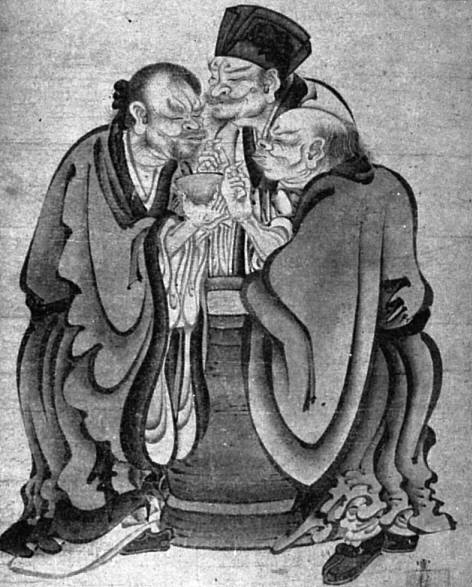
"The Vinegar Tasters", a popular allegorical painting featuring the Buddha, Lao Tzu and Confucius tasting vinegar. Each person's expression is representative of their religion's basic take on human life: Buhhda's is bitter, Confucius's is sour, and Lao Tze's is a smile.
150 BCE
The Huai-nan-tzu, another definitive text of the Taoist library, is written. It compiles a wide array of Taoist writings, serving as something of an encyclopedia featuring writings from a host of different Taoist writers. The main focus is one the subject of the cosmos, time, human action and the underlying connection between the three elements; it featured such Taoist principles as ch’i, yin and yang (the balance between two extremes or opposites that naturally asserts itself in the forces of the natural world).
220 CE
“Religious” Taoism emerges, creating a distinction between the two forms of Taoism. This form focuses more on the acting out of Taoist principles, the difference lying largely in the ceremonies and practices that take place in the monasteries and temples for religious practices that will be established in years to come, and in the belief in various deities of the Taoist world.


265-589 CE
During this time, the Period of Disunity in China, Buddhism experiences rapid growth; as a result, Taoism puts forth an effort for more prominence in Chinese culture and, thus, patronage from royalty and other powerful, wealthy people. This struggles eventually yields Zen Buddhism, a mixing of Taoist and Buddhist principles, a religion which is still popular today.


Zen gardens, one of the practices to arise from Zen Buddhism.
300 CE
Kuo Hsiang edits the text of the Chuang Tzu, resulting in text that is read today. He divides the text into 3 parts: the first consisting of 7 “inner chapters,” the second consisting of 15 “outer chapters,” and the last section of all remaining chapters known as the “miscellaneous chapters. The first section is regarded as having been written by Chuang Tzu himself, while the last two sections are thought to have been written by his followers later on, in an attempt to elaborate and clarify the principles set down in Chuang Tzu’s writing.
364 -370 CE
The Mao Shan (Shan-Ch’ing) school of Taoist thought comes into existence as a result of a series of revelations the individual Yang His receives from a series of spiritual beings from Heaven of the Highest Purity. The resulting texts were seen as holy, as they represented tangible, living embodiments of Tao as passed down directly from pure, heavenly Tao deities. The resulting sect is one of the first religious Taoists sects and one that is still influential and thriving today.
The deities of the Heaven of Highest Purity
The deities of the Heaven of Highest Purity
 .
.
Subscribe to:
Posts (Atom)